The email usually arrives on an ordinary weekday. The tenant has found a new job, or a bigger place, or they are moving in with someone, and they will be out at the end of next month. Then, a line or two later, the question that makes the next six weeks harder than they need to be: "Can we just use my deposit for the last month?"
Nothing about a move-out is complicated on its own. The trouble is that four or five small things all happen at once, over several weeks, while the tenant is still living in the unit and paying rent. Miss one and you find out months later, when a late notice goes to someone who already moved out, or the final water bill arrives after the deposit is gone.
This guide walks through those weeks in order, from the notice to the last dollar of the deposit.
Write the dates down the day the notice arrives
Before you reply, record three things: the date the notice reached you, who gave it, and the last day the tenant will be in the unit. Those three dates decide almost everything that follows.
- The notice date tells you whether the notice is long enough. Notice periods are set by the lease and by local law, and they differ a great deal. If the notice is short, decide now whether you will accept it rather than arguing about it in the last week.
- The last day in the unit sets the final rent. If it falls partway through a month, that month is a part month, not a full one.
- Who gave notice matters if anything goes wrong later. A tenant ending the tenancy and a landlord ending it are handled very differently.
Reply in writing and confirm the dates back to the tenant. A short confirmation now saves a long argument later.
First, check which deposit you are holding
Before you answer the question about the deposit, look at what you actually collected at move-in. There are two very different kinds of deposit, and they answer that question differently.
- A last month rent deposit is rent the tenant paid up front for the final month. Many landlords collect one, and in Ontario it is the deposit the standard lease provides for. If this is what you hold, there is nothing to decide: that money already is the last month of rent. Apply it to the final month, prorated if they leave partway through, and refund anything it does not use. It cannot be used for damage.
- A security deposit is held against damage and unpaid amounts after the tenancy ends. This is the one tenants ask to "just use" for the last month, and it is where the decision below comes in.
Some leases hold both. Keep them separate on paper, because they are settled differently.
Decide how the last months get paid from a security deposit
If what you hold is a security deposit, this is the decision that most move-outs turn on. There are really only two ways to do it.
| Tenant pays rent as usual | Security deposit covers the last month | |
|---|---|---|
| Rent until move-out | Paid each month, as always | Last month or months taken from the deposit |
| Deposit at move-out | Full amount available for damage and final bills | Reduced, often to nothing |
| Risk to you | Low | Damage or final bills with nothing left to cover them |
| What it needs | Nothing new | A written agreement, and local law that allows it |
Paying as usual is the safer default. The deposit stays whole until you have walked the unit and seen the final bills, which is exactly what it is for.
Using the security deposit for the last month is a reasonable request, and many landlords agree to it, especially with a tenant who has paid on time for years. But be clear about the trade. A one month deposit used as one month of rent leaves nothing for a damaged floor or a final utility bill. In many places a security deposit cannot be used this way at all unless both sides agree. If you agree, get it in writing, note the date, and decide now which months it covers.
If you agree the deposit pays September, make sure nothing in your process sends the tenant a late notice for September. An overdue email for rent you agreed was covered is the fastest way to turn a friendly move-out into a dispute.
Get the last month of rent right
Two mistakes show up again and again in the final month.
Charging a full month for a part month. If the tenant leaves on the 14th, the usual approach is to charge for the days they were there. Divide the monthly rent by the days in that month and multiply by the days occupied, counting the move-out day. At 1,650 a month, leaving on the 14th of a 30 day month comes to 770, not 1,650.
Charging rent after they leave. If your rent charges or reminders run on their own, they will keep going after the tenant is gone unless something tells them the tenancy ended. That is how a former tenant ends up with a reminder for a month they never lived in.
Utilities are the other thing to keep separate. An agreement about rent does not cover utilities you pay and bill back. If the water or hydro is on your account, the tenant still owes their share for every month they were there, including the months the deposit covers.
Plan the handover before the last week
The last week is busy for everyone. Settle the practical parts early.
- Book the move-out inspection. Walk the unit with the tenant if you can, and compare it room by room with the move-in record. Dated photos at both ends are what make a deduction stick.
- Agree how the keys come back. Every key, fob and remote, and on which day. The day the keys come back is the day the tenancy really ends.
- Ask for a forwarding address. You need it to return the deposit and send the statement.
- Read the meters on the last day. Final utility bills often arrive weeks later. A reading on the move-out day tells you what share is theirs.
If the tenant leaves earlier than planned, the rent should stop at the day they actually left, not the day in the original notice.
Settle the deposit with the numbers in front of you
When the unit is empty and the bills are in, the deposit comes down to a short list.
- A last month rent deposit, applied to the final month, with anything it does not use refunded.
- Rent you agreed would come from the security deposit, less anything the tenant paid toward those months anyway.
- Rent or charges still unpaid from the notice period.
- Final bills that arrived after the move-out, such as their share of the last utility bill.
- Damage beyond normal wear, backed by the inspection and the photos.
Itemize every line, subtract it from what you hold, and return the rest within the deadline that applies where the property is. Those deadlines are set by local law and can be short. Missing one can cost you the right to deduct anything at all, so put the date in your calendar the day the keys come back. Our guide to holding and returning a security deposit covers the statement in more detail.
When the tenant changes their mind
It happens more often than you would think. The new job falls through, or the new place is not ready, and the tenant asks to stay.
If you agree, withdraw the notice and put everything back the way it was, with one exception. If the deposit was going to cover a month that has already started, that rent is owed again. The cleanest fix is to bill it back as a single charge and keep the deposit at its full amount, so you are not left holding a smaller deposit for the rest of a tenancy that is no longer ending.
How ProperLease handles a move-out
Everything above is a lot to hold in your head for six weeks. In ProperLease you record the notice on the lease once, and the rest of the app follows it.
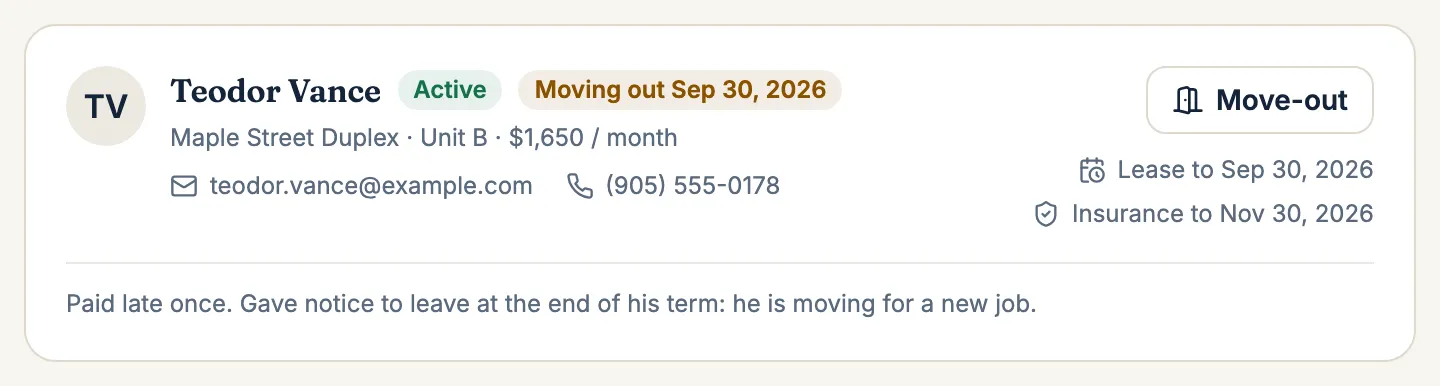
A last month rent deposit and a security deposit are recorded separately on the lease, because they do different jobs. When the lease holds a rent deposit, the notice covers the last month with it straight away. A security deposit only pays rent if you choose that, for the months you pick. Either way, covered months get no rent reminder and no overdue email, and they show as covered instead of late. Utilities stay owed and are still asked for. Rent stops at the move-out date, and a part month is prorated by the actual days.
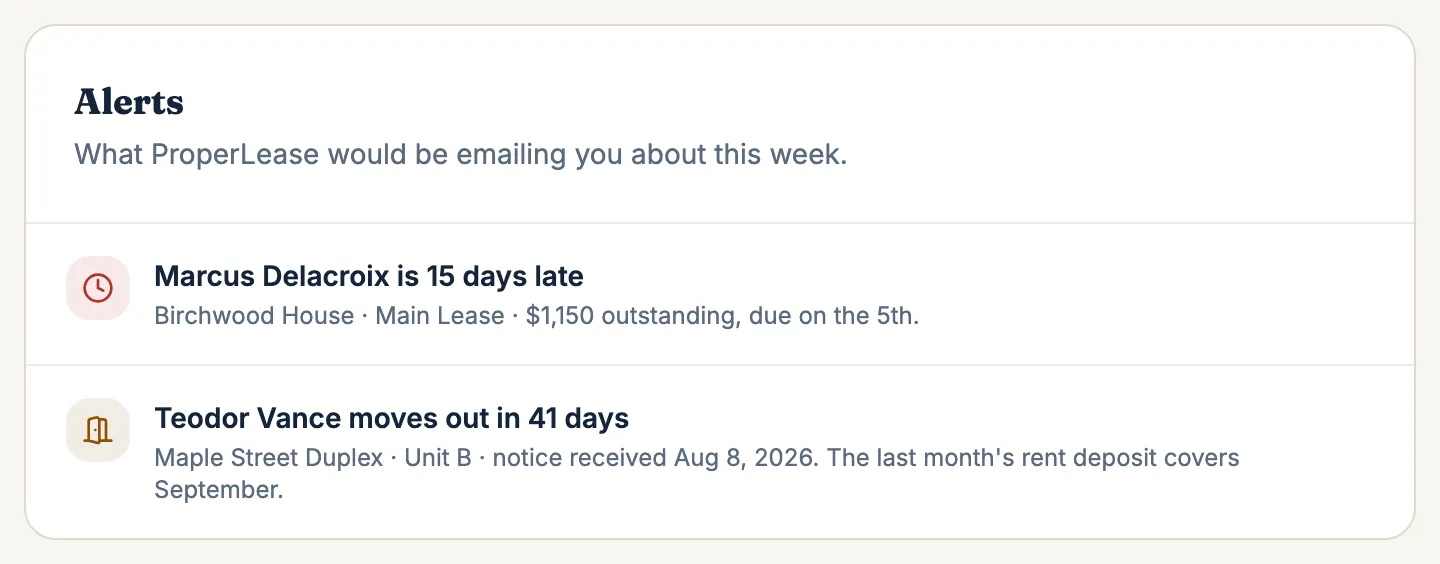
A move-out checklist on the tenant tracks the inspection, the keys, moving the tenant to Past and settling the deposit, and ticks each step off from what you record. When the keys are back, one tap applies the rent deposit to the last month, recorded as rent so it counts as income in that month, with anything unused shown as a refund. The security deposit side lists anything still unpaid and any final bills, each waiting for you to add it.
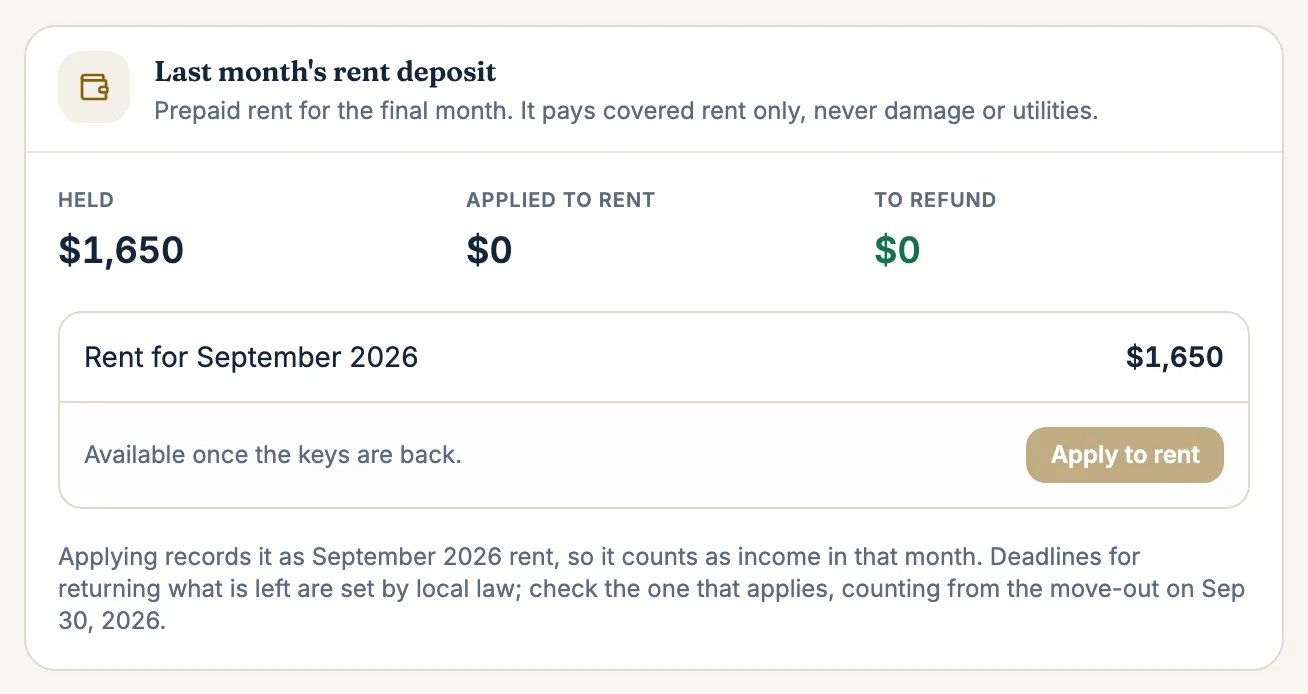
If the tenant decides to stay, withdrawing the notice bills back any covered rent already used as one charge and keeps the deposit whole, so a rent deposit stays in place for their real last month.
This is general information, not legal advice. Notice periods, whether a deposit can be used as rent, deposit interest and return deadlines are set by province and state and change over time. Confirm the rules where your property is located before you act.
To see every step in the app, read record a notice to vacate and track the move-out. Or open the live demo, go to Tenants, and choose Move-out on Teodor to walk through a sample move-out, no signup needed.
Frequently asked questions
Is a last month rent deposit the same as a security deposit?
No. A last month rent deposit is rent paid up front for the final month, applied to that month when the tenant leaves, with anything unused refunded. A security deposit is held against damage and unpaid amounts. Some leases hold both, and they are settled separately.
Can a tenant use the security deposit as last month rent?
Only if you agree to it, and only where local law allows it. In many places a security deposit is meant to cover damage and unpaid rent after the tenancy ends, so a tenant cannot simply stop paying the last month. If you do agree, put it in writing and remember that whatever the deposit pays toward rent is no longer available for damage.
How do I work out rent for a partial last month?
The usual approach is daily proration. Divide the monthly rent by the number of days in that month and multiply by the days the tenant is in the unit, counting the move-out day. A tenant paying 1,650 who leaves on the 14th of a 30 day month owes 770 for that month.
Does the tenant still owe utilities if the deposit covers the last month of rent?
Yes. An agreement about rent does not cover utilities you pay and bill back. Those stay owed, and the final utility bill, which often arrives after the move-out, can be deducted from what is left of the deposit if the tenant has not paid it.
What if the tenant changes their mind and wants to stay?
Withdraw the notice before the keys come back. Any rent the deposit was going to cover for months that have already started is owed again, so bill it back and keep the deposit at its full amount.
Run your rentals with absolute clarity
ProperLease helps self-managing landlords in Canada and the US track rent, generate provincial and state leases, serve notices, and stay tax ready.