If you own rental property in Canada, the T776 is the form that turns a year of rent and receipts into a single number: your net rental income. It is called the Statement of Real Estate Rentals, and it attaches to your personal T1 return. Understanding what each line wants makes tax season faster and, more importantly, makes sure you claim every dollar you are entitled to.
This is a plain guide to what the T776 reports, which expenses belong on it, and how to walk into your accountant's office already organized.
This article explains how the T776 works in broad terms. Your situation may have wrinkles this cannot cover, so confirm the specifics with an accountant before you file.
What the T776 actually reports
The T776 does one job: it calculates net rental income for a property or group of properties. You start with gross rents, subtract the expenses you paid to earn that rent, and the difference is what you report as income. If expenses exceed rent, you may have a rental loss, which has its own rules.
The form is organized by property, and if you own more than one, each property carries its own share of income and expenses. That per property breakdown matters, because a strong year on one door can quietly hide a weak year on another if you only look at the total.
Gross rents: start at the top
Gross rents are the total rent you were entitled to receive during the year, before any expenses. This includes the base rent plus amounts a tenant pays you for things like parking, storage, or a share of utilities.
Record rent when it is earned, not only when it clears. A tenant who pays January rent on December 28 and another who pays late in the new year both belong in the correct period. A dated ledger of every payment makes this line accurate instead of a best guess in April.
The main deductible expense lines
Most of a landlord's tax savings live in the expense section. These are the current operating costs of running the rental, and the T776 gives each its own line. The common ones:
- Advertising: listing fees and ads to find tenants.
- Insurance: the property and liability coverage on the rental.
- Interest: the interest portion of your mortgage, plus interest on loans used for the property. Principal repayment is not deductible.
- Maintenance and repairs: fixing what is already there, like a leaking faucet or a repainted wall.
- Management and administration fees: amounts paid to a property manager or agent.
- Professional fees: accounting and legal costs related to the rental.
- Property taxes: municipal taxes on the rental property.
- Utilities: heat, hydro, water, and similar costs you cover rather than the tenant.
Mapping your costs to the right line
The hardest part for most landlords is not paying the expense, it is remembering which line it belongs on ten months later. This table maps common costs to their T776 home.
| What you paid | T776 line |
|---|---|
| Online listing or newspaper ad | Advertising |
| Building and liability insurance | Insurance |
| Mortgage interest (not principal) | Interest |
| Plumber, appliance repair, repaint | Maintenance and repairs |
| Property manager commission | Management and administration fees |
| Accountant or lawyer for the rental | Professional fees |
| Municipal property tax | Property taxes |
| Heat, hydro, water you cover | Utilities |
| Condo or strata fees | Other expenses |
For a fuller breakdown of what does and does not qualify, see what rental expenses are actually tax deductible.
Current expenses versus capital expenses
This is the distinction the CRA cares about most, and the one that trips up landlords. A current expense keeps the property in the same condition it was already in, and you deduct the full amount in the year you pay it. A capital expense improves the property or gives a lasting benefit, and it cannot be deducted all at once.
Replacing a broken window pane is a current expense. Replacing every window in the building with a better model is capital. Fixing a section of roof is current; a brand new roof is capital. When the work betters the property beyond its original state or has an enduring benefit, treat it as capital and talk to your accountant about how to handle it.
A note on CCA
Capital expenses are not lost, they are deducted slowly through capital cost allowance, or CCA. CCA lets you claim a percentage of the building's value each year as depreciation.
CCA is optional, and it is a genuine planning decision rather than a box you must tick. Claiming it lowers your income now, but it can create a recapture tax bill when you sell, and it can affect the principal residence treatment in some situations. ProperLease organizes the income and operating expenses that feed the T776; the CCA calculation itself is something you set with your accountant, who can weigh the trade off for your circumstances.
Be ready before your accountant asks
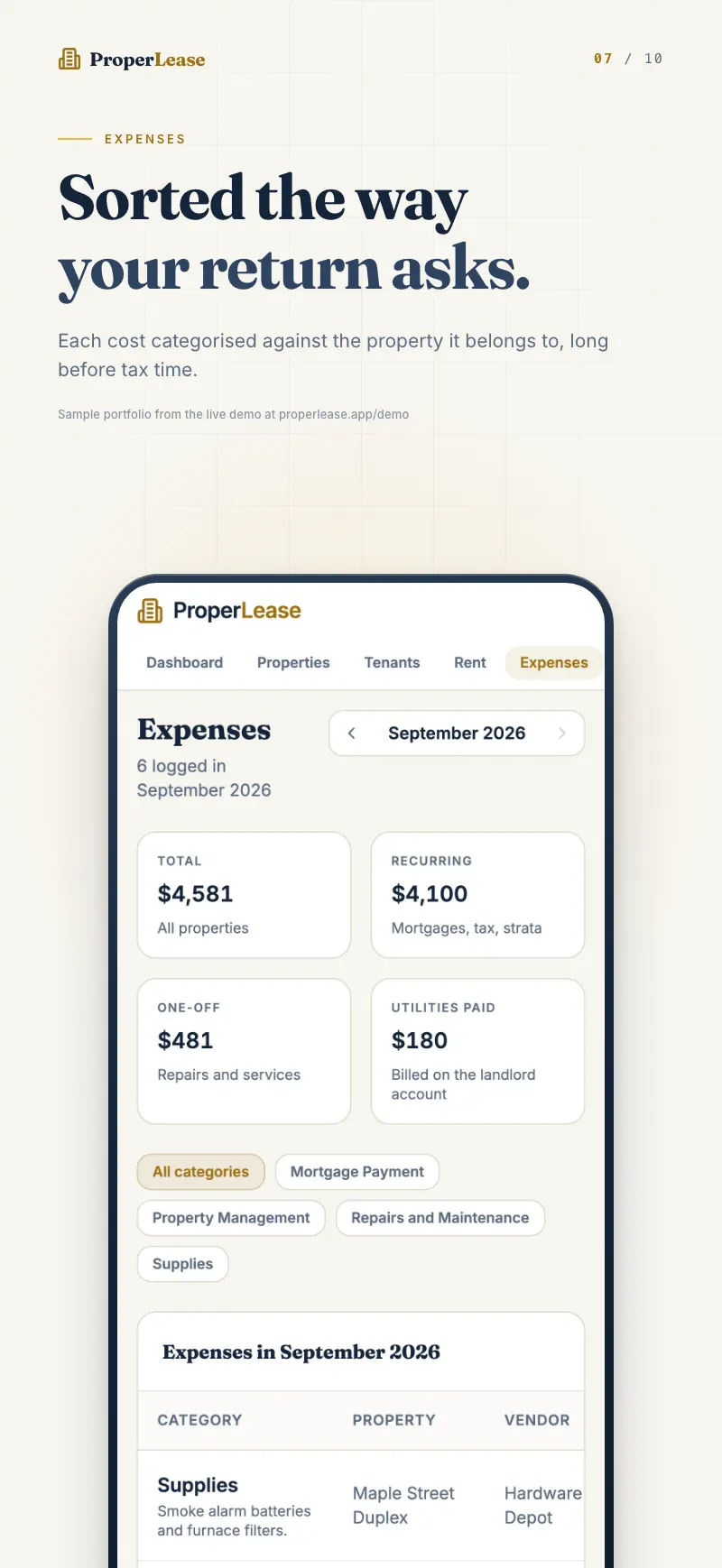
The landlords who dread tax season are the ones assembling records from scratch in April. The ones who do not are simply tagging each cost as it happens. When you log an expense, mark whether it is deductible, note the property, and the year-end total builds itself.
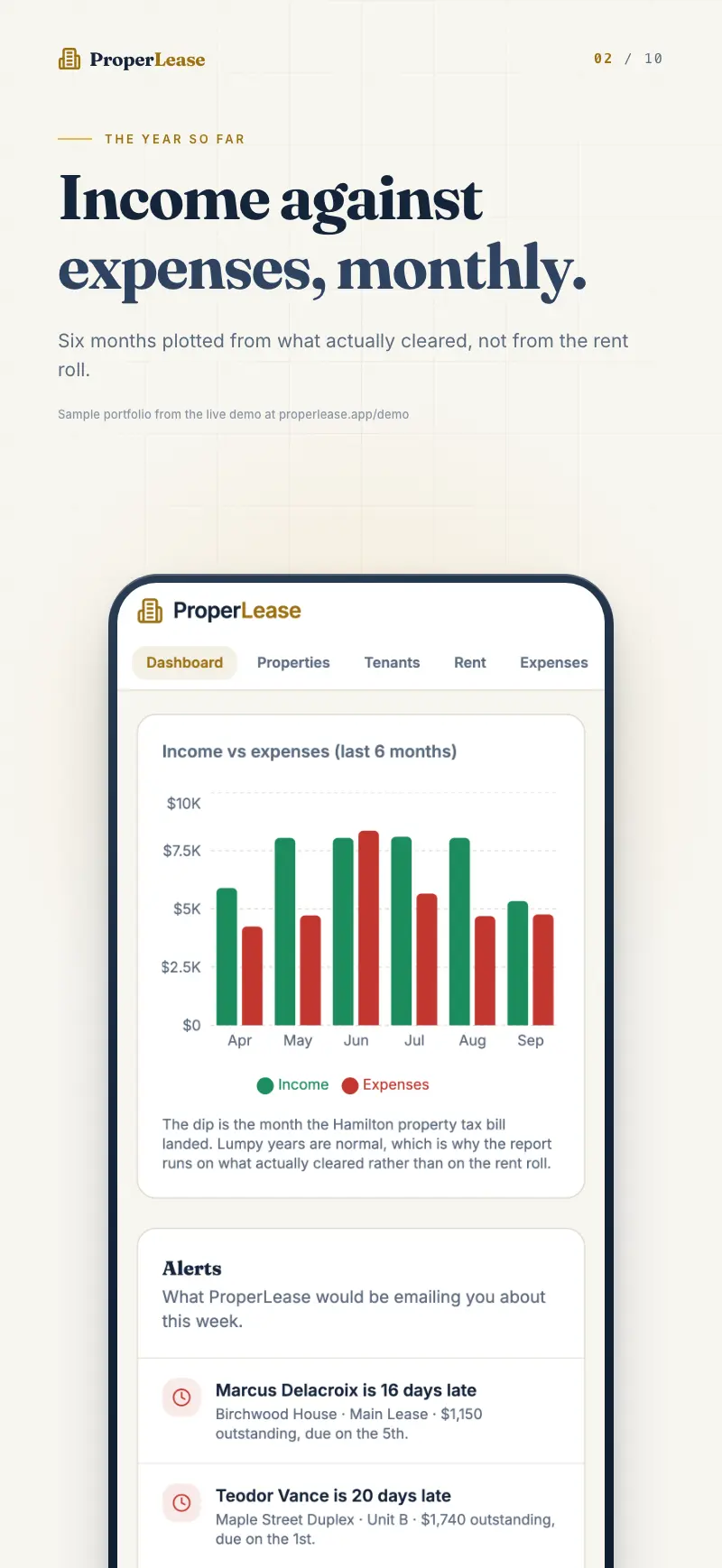
ProperLease exports a year-end report with income, expenses, and cashflow already sorted into T776 aligned categories and broken down by property. You hand your accountant a clean statement instead of a shoebox, and you can see your net position on every door long before the deadline.
When you are ready to pull it together, the year-end tax reports guide walks through the export step by step. Get organized once, and the T776 stops being a scramble and becomes a five minute review.
Frequently asked questions
What is the T776 form used for?
The T776, Statement of Real Estate Rentals, is where Canadian landlords report gross rents and deduct operating expenses to arrive at net rental income, which then flows onto your personal T1 return.
Can I deduct my mortgage payment on the T776?
You can deduct the interest portion of your mortgage, but not the principal. The principal repayment builds your equity and is not an expense, so only the interest goes on the interest line.
Do I have to claim CCA on my rental property?
No. Capital cost allowance is optional. Many landlords skip it to preserve the principal residence style treatment on a future sale, but this is a decision to make with your accountant.
When is the T776 due?
It is filed with your personal T1 return, generally due April 30. If you or your spouse are self-employed the T1 deadline is June 15, but any balance owing is still due April 30.
Run your rentals with absolute clarity
ProperLease helps self-managing landlords in Canada and the US track rent, generate provincial and state leases, serve notices, and stay tax ready.