Every landlord wants the same two things at tax time: to claim every dollar they are owed and to claim nothing they are not. The gap between those two is where audits and missed deductions live. The good news is that the rule for what qualifies is simpler than it looks, and once you know it, most costs sort themselves.
This guide covers the general rule, a clear list of what does and does not count, the current versus capital line, and the habit that makes the whole thing effortless. It applies to landlords in both Canada and the US, though the form you file differs.
This explains deductions in plain terms. Rules have exceptions and your situation may differ, so confirm specifics with an accountant before you file.
The general rule
Across both countries, the test is the same in spirit: an expense is deductible when it is an ordinary and necessary cost of operating the rental to earn income. Ordinary means it is a normal cost for a rental business. Necessary means it is helpful and appropriate for running the property.
The rent your tenant pays is income. The insurance, the repairs, the interest, the management fee, and the utilities you cover are the costs of producing that income, so they come off the top. What fails the test is anything personal, anything that builds your own equity, and anything that is really an investment in the property rather than an operating cost.
Deductible versus not deductible
Most confusion clears up with a side by side list. This table covers the items landlords ask about most.
| Deductible | Not deductible |
|---|---|
| Mortgage interest | Mortgage principal |
| Property insurance | Your own labor and time |
| Repairs and maintenance | Capital improvements (deducted over time instead) |
| Property taxes | Fines and penalties |
| Utilities you pay | Utilities the tenant pays |
| Property management fees | Personal use portion of the property |
| Advertising for tenants | The land's value |
| Professional fees for the rental | Personal legal or accounting costs |
| Mileage for rental trips | Commuting or personal travel |
Two lines in that table cause the most trouble. Mortgage principal feels like an expense because the cash leaves your account, but it repays your loan and builds equity, so only the interest is deductible. And your own labor, however many weekends it eats, was never an out of pocket cost, so it cannot be claimed. Pay a contractor and that invoice is deductible.
Current versus capital: the line that matters most
The biggest single distinction is between a current expense and a capital expense. A current expense keeps the property in the condition it is already in, and you deduct it in full the year you pay it. A capital expense improves the property or gives a lasting benefit, and instead of a one time deduction it is recovered slowly through depreciation in the US or capital cost allowance in Canada.
Fixing a leaking faucet is current. Renovating the whole bathroom is capital. Patching a worn section of roof is current; replacing the entire roof is capital. Ask yourself whether you restored what was there or upgraded it. If the work betters the property beyond its original state, treat it as capital and set it up with your accountant.
Track receipts and mileage as you go
A deduction you cannot document is a deduction you may lose. Both the CRA and the IRS can deny an expense with no proof behind it, so a dated record and a receipt for each cost is not optional, it is the deduction.
Mileage is the one landlords forget. Trips to the property to inspect, to meet a contractor, or to collect rent can be deductible, but only with a log of the date, distance, and purpose. A note in the moment is worth far more than a guess in April.
Tag as you go, not in a shoebox
Here is the habit that separates a calm tax season from a stressful one. Every expense gets tagged the moment it happens: which property, whether it is deductible, one time or recurring. Do that all year and your total is already built when the deadline arrives.
ProperLease puts a deductible toggle on every expense, keeps costs separated by property, and can create an expense automatically from a maintenance job so the receipt never goes missing. Import what you already have from QuickBooks or a CSV, and it all syncs between the iPhone and web apps so you can log a cost the second you pay it.
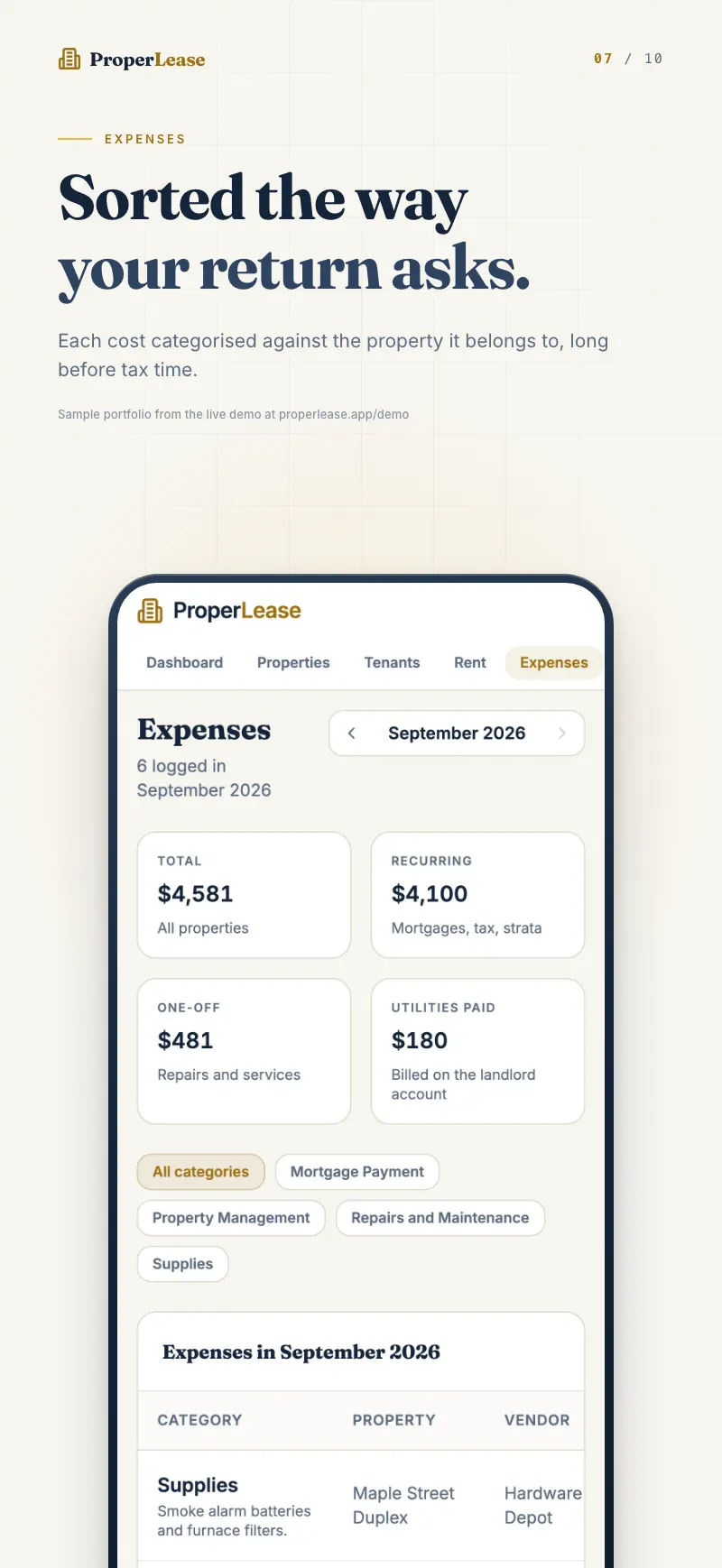
When the year ends, the totals are ready for the form you file, whether that is the T776 in Canada or Schedule E in the US. The track expenses guide shows how to set the habit up. Do the small thing each week and the shoebox never fills.
Frequently asked questions
What is the basic rule for a deductible rental expense?
An expense is generally deductible if it is an ordinary and necessary operating cost incurred to earn rental income. Personal costs and the parts of a payment that build equity, like mortgage principal, do not qualify.
Can I deduct my own labor on the rental?
No. The value of your own time and labor is not deductible because it was never an out of pocket cost. You can deduct what you pay a contractor or handyman to do the same work.
Is a mortgage payment deductible?
Only the interest portion. The principal portion repays the loan and builds your equity, so it is not an expense. Insurance and property taxes bundled into the payment are deductible separately.
Do I need receipts for every deduction?
Yes. Keep a dated record and receipt for each expense. If the CRA or IRS asks, an undocumented deduction can be denied, so tag and store proof as you spend rather than reconstructing it later.
Run your rentals with absolute clarity
ProperLease helps self-managing landlords in Canada and the US track rent, generate provincial and state leases, serve notices, and stay tax ready.