Utilities are where a lot of otherwise organized landlords quietly lose money. The bill arrives in your name, you pay it to keep the service on, and the reimbursement from tenants slips through the cracks. Do that a few months running, across a few units, and you have eroded real cashflow without ever seeing a single dramatic expense.
The fix is not complicated, but it does have to be deliberate. Decide who pays what, choose a billing method that fits the property, and track recovery as carefully as you track rent.
Start with the lease: who pays what
Every utility headache traces back to a lease that was vague about responsibility. Before you worry about how to bill, make sure each utility has a named party who pays it.
For each service, water, gas, electricity, heat, internet, and any others, the lease should say plainly whether the tenant holds the account or the landlord covers it and recovers the cost. Leave nothing to assumption. A tenant who was never told they owe for water will, understandably, refuse to pay for it later.
- Separately metered and in the tenant's name. Simplest case. The tenant contracts directly and you are not involved in billing at all.
- In the landlord's name, single unit. You pay, then recover from the one tenant by a flat charge or the actual bill.
- Shared across multiple units. You pay one bill for the building and split it. This is where a clear, written method is essential.
Flat rate, metered, or chargeback
Once responsibility is clear, pick how you bill. There are three common approaches, and the right one depends on how predictable the cost is and how much precision you want.
| Method | How it works | Best when |
|---|---|---|
| Flat rate | A fixed monthly amount added to rent | Costs are stable and you want simplicity |
| Metered | The tenant pays the utility directly on their own meter | Each unit is separately metered |
| Chargeback | You pay the actual bill, then bill each tenant their share | Utilities are shared or in your name and costs vary |
A flat rate is the easiest to administer, but it cuts both ways: a mild month means you keep a little extra, a brutal cold snap means you eat the overage. A chargeback passes the real cost through, so you are never subsidizing a heat wave or an unusually heavy month. In ProperLease you record the bill under Utilities, mark who pays, and issue a chargeback to the tenant, all tracked against the property.
Use a flat rate for costs that barely move, like a small water bill, and a chargeback for anything that swings with the weather or usage, like heat and electricity. Mixing methods per utility is perfectly reasonable and usually the most accurate approach.
Splitting shared utilities fairly
When one bill covers several units, the split has to feel fair or it becomes a source of constant friction. There is no single correct formula, but there is one rule: choose a basis, write it into every lease, and apply it the same way every month.
Common bases for the split:
- Equal shares. Divide the bill by the number of units. Simple and easy to defend when units are similar in size.
- By occupancy. Divide by the number of people, which better reflects water and heat use in mixed unit sizes.
- By square footage. Larger units carry a larger share, which tends to be fairest for heating.
Whatever you pick, consistency is what keeps it defensible. A tenant who can see the method spelled out in their lease, and see that everyone is treated by the same rule, rarely disputes their share.
Track who has paid, every month
Billing the tenant is only half the job. The other half is confirming the money came back, and this is exactly where casual tracking fails. A utility charge is easy to send and even easier to forget to collect.
Treat each utility bill like a small invoice: record the bill, record the chargeback to the tenant, and mark it paid only when the reimbursement actually arrives. That way an unpaid utility surfaces the same way overdue rent does, instead of hiding inside a general sense that the numbers are roughly right. The utilities and chargebacks guide shows how the paid status and chargebacks work inside the app.
How unrecovered utilities erode cashflow
Here is the part that stings. A single unrecovered utility bill feels minor, so it never triggers alarm. But unrecovered utilities are a recurring leak, and recurring leaks are what separate the rent you collect from the cashflow you actually keep.
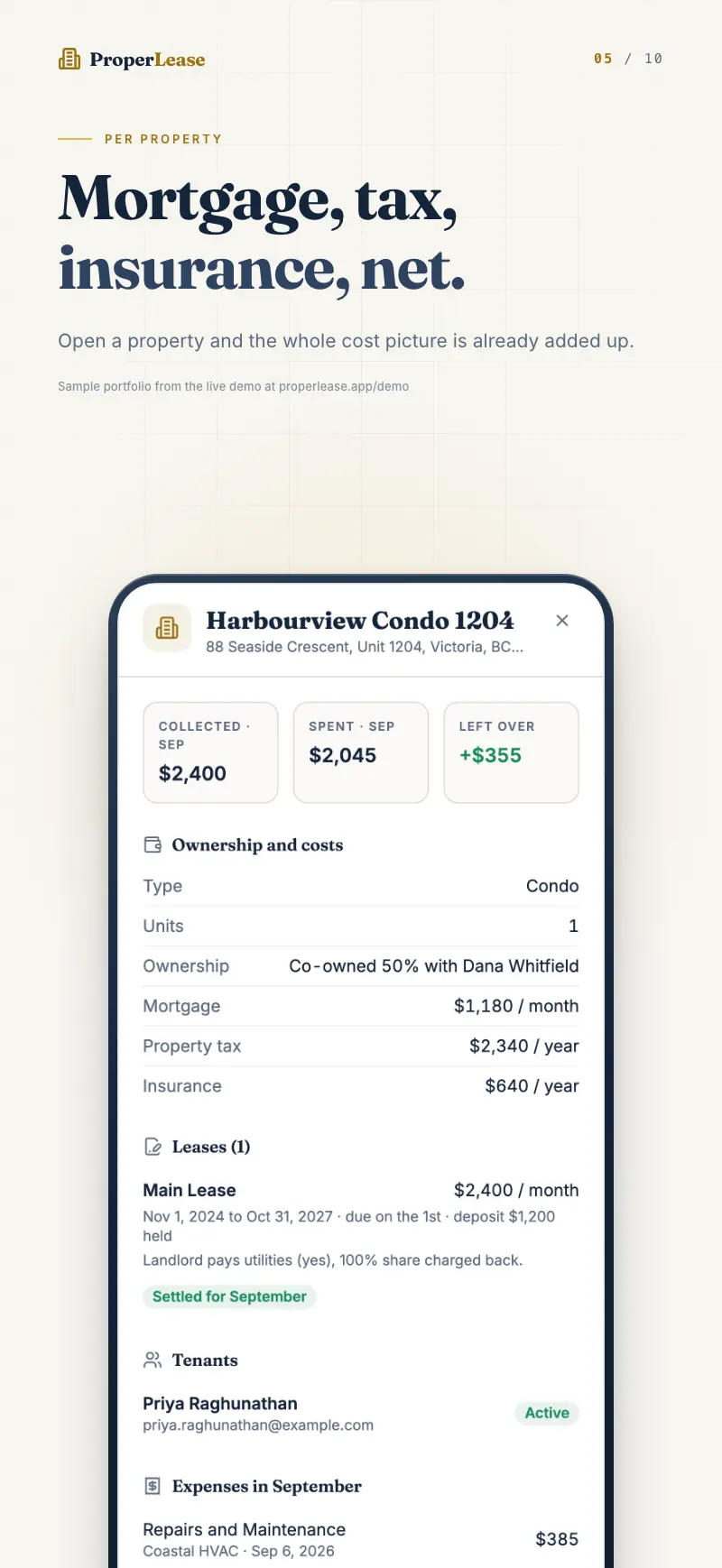
Your real cashflow is income minus every expense, and a utility you paid but never billed back sits squarely on the expense side with nothing to offset it. Multiply a modest monthly shortfall across several units and a full year and the number stops being trivial. This is one of the clearest examples of the gap between rent collected and money kept, which is worth understanding in full: see know your real cashflow.
Bill utilities deliberately, split them by a written rule, and confirm every reimbursement, and this whole category stops being a headache. It becomes just another line that reconciles cleanly, month after month, instead of a quiet drain you only notice at tax time.
Frequently asked questions
Should tenants pay for utilities or the landlord?
It depends on the setup and the lease. Where each unit is separately metered, tenants usually hold the accounts directly. Where utilities are shared or in the landlord's name, the landlord pays the bill and recovers the cost through a flat charge or a chargeback.
How do I split shared utilities between units?
Pick a fair, written basis and apply it consistently: an equal split, a split by number of occupants, or a split by unit square footage. State the method in each lease so no tenant is surprised by their share.
What is a utility chargeback?
A chargeback is when the landlord pays the actual utility bill, then bills each tenant their portion. It passes through the real cost rather than a fixed estimate, so you neither overcharge the tenant nor absorb a spike yourself.
Run your rentals with absolute clarity
ProperLease helps self-managing landlords in Canada and the US track rent, generate provincial and state leases, serve notices, and stay tax ready.